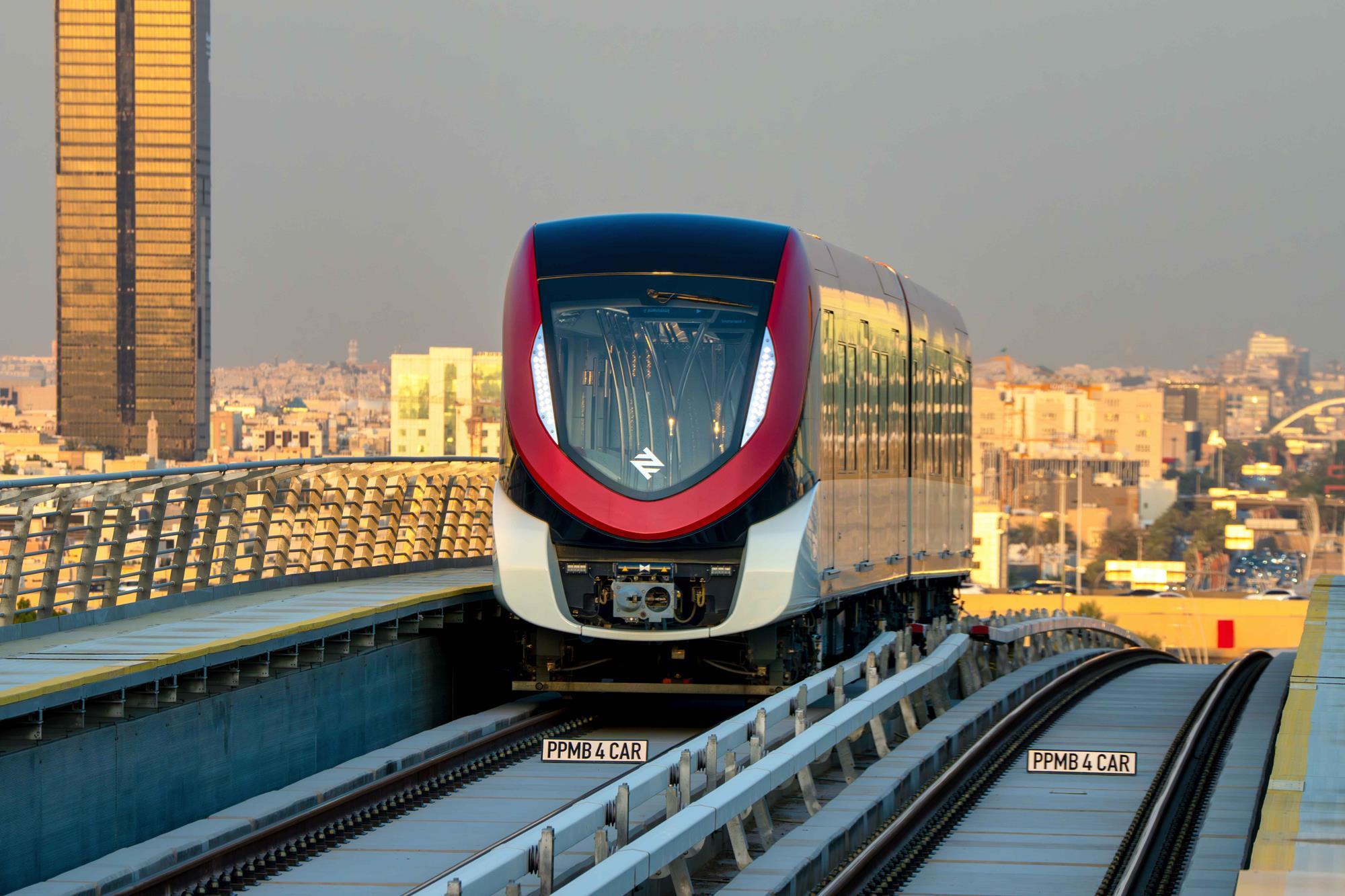
Our safety assessors were appointed to assure that the highest possible safety standards were applied throughout the design, construction and ongoing operation of Riyadh’s new mass transit system.
A City Poised for Transformation
Situated in the centre of the Kingdom of Saudi Arabia, Riyadh is the most populous city on the Arabian Peninsula and home to approximately 7.5m people.
Since the opening of King Khalid International Airport in 1983, rapid urbanisation brought with it many of the challenges faced by all metropolitan centres across the world. Here was a major international city without any form of mass transit to alleviate the notorious traffic gridlocks that built every day on its main thoroughfares.
In 2013, the Royal Commission for Riyadh City (RCRC) awarded three separate Design and Construction (D&B) contracts to construct a 176km six-line automated metro network that, once fully complete, would be the largest driverless urban transit system in the world.
Six-line automated metro network (km)
176
Passenger journeys (million)
+200
Location
- Riyadh, Saudi Arabia
Client
- Royal Commission for Riyadh City
Project Status
- Completed
Integrated Safety Across Six Lines
Covering all six lines, WSP Assurance’s E-ISA services centred around the assessment and auditing of the safety management and safety assurance activities for the three Design & Build Consortiums (BACS, FAST and ANM), with respect to their responsibilities for the design, build, manufacture, integration, testing, commissioning and handover of the railway engineering systems, both at individual subsystem and the overall integrated system level. Our remit included safety plans, hazard logs, detailed design and final engineering safety cases, also covering the verification and validation throughout all testing and acceptance activities.
Furthermore, for the two appointed Operations and Maintenance contractors, CAMCO (who manage Lines 1 and 2) and FLOW (Lines 3-6), our teams were tasked with assessing operational and maintenance readiness (for both trial running and passenger service), as well as rule books, hazard logs and day-to-day operational processes and plans. From the very outset, our teams built strong working relationships with all relevant stakeholders, meeting regularly to offer guidance, where appropriate, and ensure the assessments contributed positively to the project’s progress, and could be undertaken without impacting adversely on project programme schedules and deadlines.

At an early stage of the project, for example, an ‘approvals routemap’ was developed so that all parties understood the path to acceptance and how specific deliverables and documents could be brought together in an efficient manner as the work progressed.
Our assessors also worked with teams across the project to adopt an appropriate risk ranking matrix for demonstrating the achievement of the ‘As Low As Reasonably Practicable’ (ALARP) principle and helped ensure that it was consistently applied across the project, in accordance with CENELEC standards and railway guidance. Operational safety measures were also closely examined, ranging from the presence of the physical at-grade barrier (an important safety measure) that segregates the metro from the adjacent highway traffic, through to emergency evacuation plans for a climate where external temperatures can approach 50 degrees.
It’s a remarkable achievement. Six new lines built at the same time together, each equipped with cutting-edge driverless technologies and serving stations furnished with modern facilities and featuring expansive station concourses with some awe-inspiring architecture. I’m extremely proud of the role our team played in assuring the system safety on this project.
Dan Wardle, WSP Assurance Project Director
Setting New Global Benchmarks
E-ISA assessment reports were produced for each major project lifecycle phase for all six of the lines, helping the project to obtain the necessary approvals and secure the Safety Certificates and the Operating Licenses issued by the Transport General Authority (TGA) – the railway regulator for Saudi Arabia.
The first lines opened for passenger operation in 2024. By summer 2025 all six lines were in operation, making it the world’s largest driverless (GoA4) metro system.
Within 12 months of operation the network had already surpassed 200m passenger journeys with on-time performance exceeding 99.5%.
Plans are already being developed for an extension to Line 2 and for the construction of Line 7, which is intended to connect King Khalid International Airport with other ambitious development projects currently underway to the west of Riyadh.

Note: This assignment was originally undertaken by Ricardo Certification, which was appointed to the project in 2015. Ricardo Certification transitioned to become WSP Assurance in 2026 and operates as an independent entity.