Discover how Saudi Arabia’s Haramain High Speed Rail and national train network are reshaping travel between holy cities, coastal hubs and desert heartlands.
Train travel in Saudi Arabia has transformed dramatically in less than a decade, turning a country long associated with highways and domestic flights into one of the Middle East’s emerging rail hubs.
At the center of this shift is the Haramain High Speed Rail, a fast, comfortable link between the holy cities of Makkah and Madinah, supported by an expanding national network that now connects Riyadh, Dammam, the northern frontier and key industrial zones. For visitors and residents alike, rail is becoming one of the most efficient and atmospheric ways to cross the kingdom’s vast desert landscapes.
The Rise of Modern Rail in Saudi Arabia
Saudi Arabia’s embrace of rail is closely tied to the country’s Vision 2030 agenda, which prioritizes better connectivity, tourism growth and more sustainable transport options. Historically, long distance mobility relied on domestic flights or long drives on multilane highways. Today, new and upgraded rail corridors are beginning to stitch together the kingdom’s main cities and industrial regions, offering a different perspective on its deserts, plateaus and coastal plains.
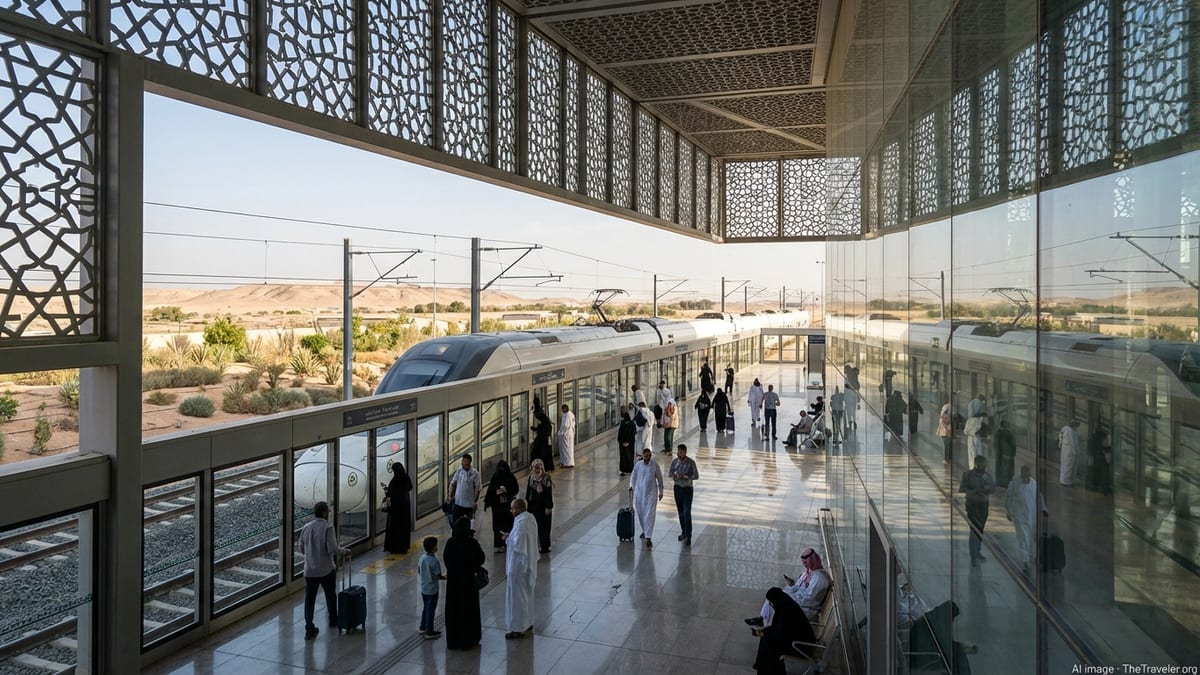
The flagship of this new era is the Haramain High Speed Railway, a 450 kilometer line between Makkah and Madinah with intermediate stops in Jeddah, King Abdulaziz International Airport and King Abdullah Economic City. Operating at speeds of up to 300 kilometers per hour, it cuts typical travel time between the two holy cities to around two hours and has become an essential part of Hajj and Umrah logistics, especially in peak seasons when road traffic is heaviest.
Alongside Haramain, Saudi Arabia Railways operates the North Train and East Train networks, which together extend thousands of kilometers from Riyadh to the Jordanian border and to the Gulf coast at Dammam. These routes began primarily as freight and mineral corridors but now carry passengers across a large swath of the country. For travelers, the result is a growing menu of rail journeys that combine practical convenience with a striking sense of distance and landscape.
Future projects, including a planned land bridge between Riyadh and Jeddah, aim to close remaining gaps between the Red Sea and Arabian Gulf. While timelines and scope may evolve, the overall direction is clear. Rail is moving from supporting role to backbone, especially on heavily traveled domestic corridors where it can ease pressure on airports and highways.
Inside the Haramain High Speed Rail Experience
The Haramain High Speed Rail is designed as a modern, mostly reserved seat service that feels closer to European or East Asian high speed lines than to traditional regional trains. Trains are electric, with sleek white and silver exteriors that stand out against the tan and ochre tones of western Saudi Arabia. Interiors are air conditioned, bright and relatively spacious, with large windows framing the passing desert and low escarpments. More
By Monika Lewicka https://www.thetraveler.org/